Diabetic Retinopathy and Macular Disease
Diagnosis and treatment of diabetes-related retinal damage and macular disease.
General description
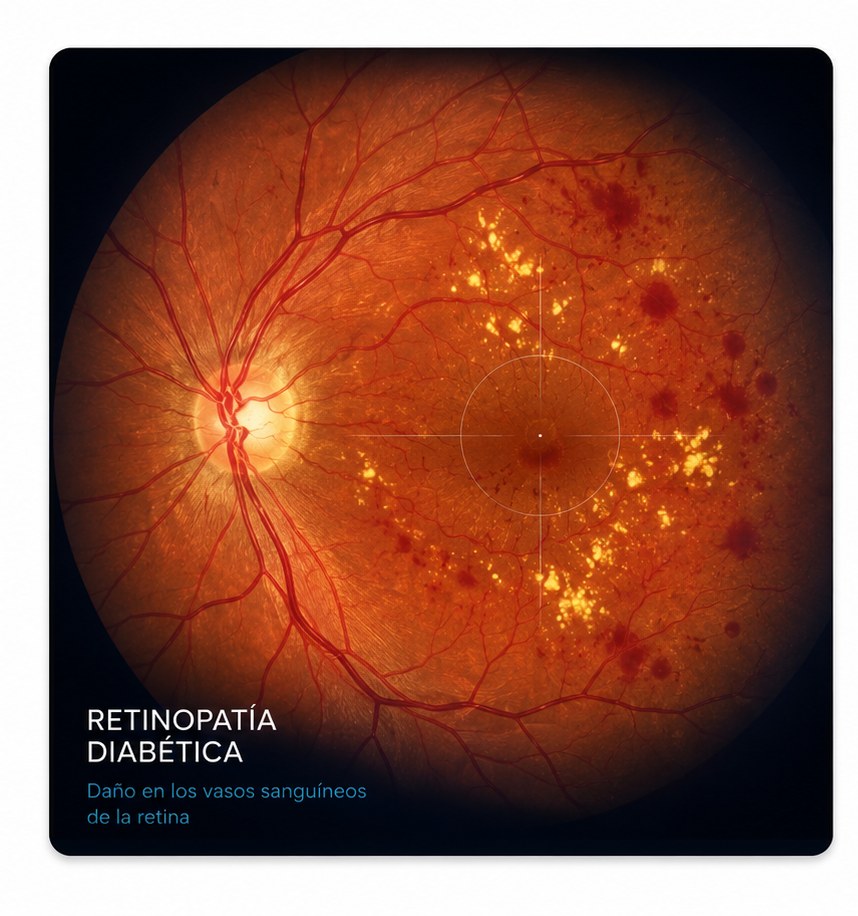
The retina and macula —the area responsible for sharp, central vision— can be affected by different conditions: diabetic retinopathy, which damages the retina's blood vessels as a complication of diabetes, and other diseases such as age-related macular degeneration or macular edema, which can affect reading, facial recognition, and other daily activities. We use high-resolution optical coherence tomography (OCT) for early, precise diagnosis, always evaluated by a physician with advanced specialty training in retina care.
What does treatment involve?
Anti-VEGF (anti-angiogenic) injections
Anti-VEGF (anti-angiogenic) medications block the substance that causes abnormal blood vessel growth and inflammation in the retina and macula, whether from diabetic retinopathy, age-related macular degeneration, or other causes of macular edema. They're given as an intravitreal injection: a very fine injection, with local anesthetic drops, that takes only a couple of minutes and is virtually painless. No rest is required — you can go back to your normal activities the same day. The same retina specialist who gives you the injection schedules a follow-up visit one month later, at no cost, to see how the treatment is working.
Pan-retinal photocoagulation laser
In advanced diabetic retinopathy, pan-retinal photocoagulation laser is applied to the peripheral areas of the retina to reduce the damaged tissue's oxygen demand and slow the formation of abnormal vessels, stabilizing the retina long-term. It feels like flashes of light and, occasionally, a mild pinching sensation during application; it's performed in-office, with anesthetic drops, over one or several short sessions. No rest or medication is needed afterward. The retina specialist schedules a follow-up visit one month later, at no cost, to review how the treatment is working.
Surgery: vitrectomy (with or without phaco)
In more advanced cases —such as persistent vitreous hemorrhage or tractional retinal detachment— a vitrectomy is performed, with or without combined cataract (phaco) surgery depending on the case, to remove the affected vitreous gel and release traction on the retina. Depending on severity, silicone oil, gas, air, or saline solution may be placed inside the eye at the end of surgery to help hold the retina in place while it heals. This surgery does require rest (the recommended head positioning depends on the bubble or substance placed inside the eye). We include, at no cost, the post-surgical kit with your starter treatment drops, and one month of follow-up consultations at no cost with the same retina specialist who performed your surgery.
Keeping your diabetes well controlled matters: when blood sugar isn't well managed, more injections or additional laser sessions are typically needed to keep the retina stable. For macular degeneration and other non-diabetic causes of macular edema, the retina specialist determines treatment frequency based on each patient's response.
Care during treatment
Care depends on the treatment modality indicated for your case —detailed in each section above—: injections and laser do not require rest or additional medication, while vitreoretinal surgery does require rest and post-surgical care, including the no-cost kit with starter treatment drops.
Follow-up
Whatever the treatment, follow-up is always carried out by the same retina specialist who evaluated your case, with a no-cost check-up visit one month later to review your response to treatment.
Other treatments
LASIK
Laser refractive surgery to correct nearsightedness, farsightedness and astigmatism.
Learn more